

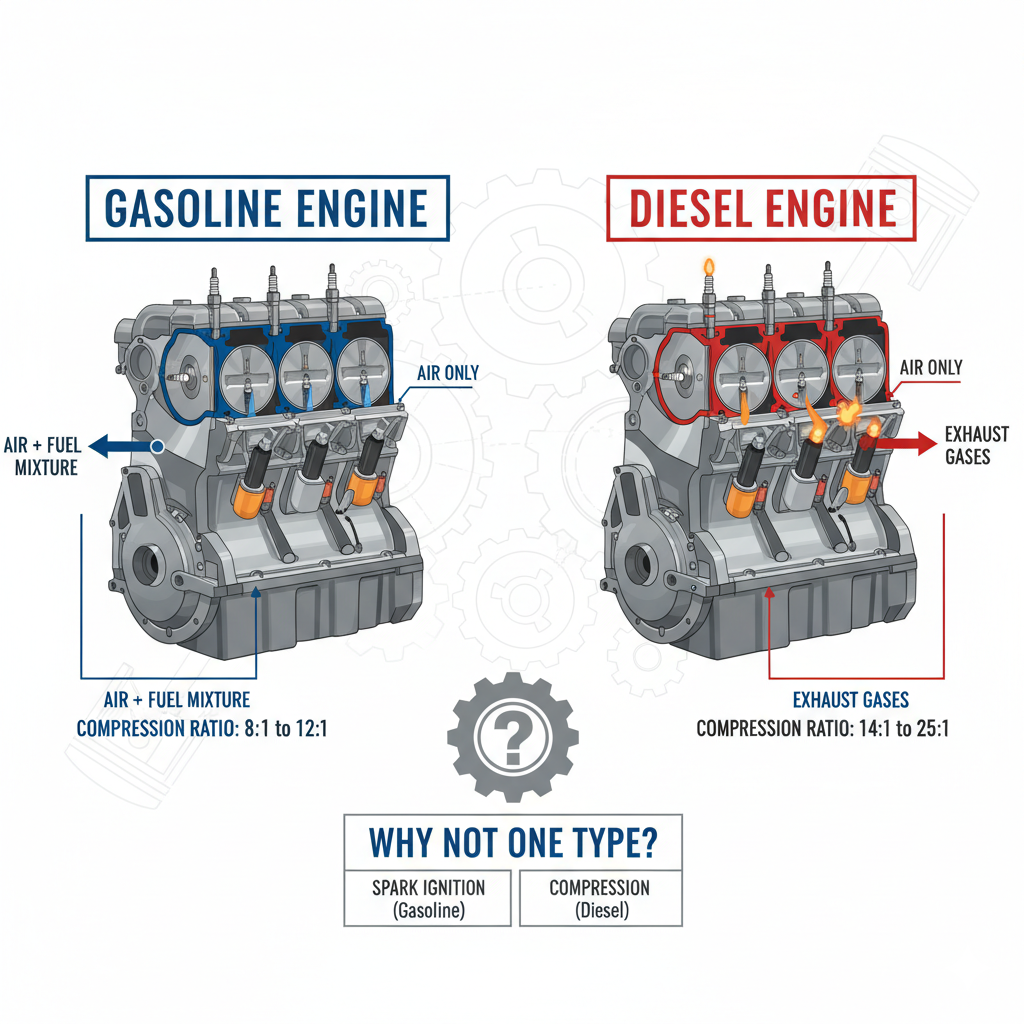
Why don’t we just use one type of engine instead of gasoline and diesel?
03
Th5
Th5
This is a very practical question. The truth is: we cannot rely on only one type of engine for all purposes, which is why both gasoline and diesel engines exist.
1. Different engines serve different purposes
No engine can be powerful, fuel-efficient, quiet, cheap, and durable all at the same time.
- Gasoline engines: smoother, lighter, more flexible
- Diesel engines: stronger, more durable, more fuel-efficient
👉 If we only used one type, some needs would not be met.
2. Different operating principles
- Gasoline engines use spark plugs to ignite fuel
- Diesel engines rely on high compression for self-ignition
👉 These two systems are fundamentally different. Combining them would:
- Increase complexity
- Raise costs
- Reduce efficiency
3. Economic and practical considerations
If only gasoline engines existed:
- High fuel consumption under heavy loads
- Faster wear and tear
- Not suitable for industrial use
If only diesel engines existed:
- Too expensive for small applications
- Noisier and more vibration
- Harder cold starts
👉 In short:
- Diesel = best for heavy-duty work
- Gasoline = best for light-duty use
4. Real-world industry choices
- Motorbikes, passenger cars → mostly gasoline
- Trucks, construction machines, forklifts → diesel
👉 Manufacturers choose based on efficiency and real-world performance.
5. Are hybrid solutions possible?
Yes, such as:
- Hybrid engines (gasoline + electric)
- Advanced technologies like HCCI
👉 However:
- Higher cost
- More complexity
- Not yet a full replacement
6. Conclusion
It’s not about preference, but optimization:
👉 Each engine type is designed for a specific purpose
👉 There is no one-size-fits-all solution
💡 Simple way to understand:
- Gasoline engine = motorbike for city use
- Diesel engine = truck for heavy-duty work