

Why Are Forklifts Divided into Narrow Forks and Wide Forks? How to Choose the Right One
Th4
1. What Are Narrow Fork and Wide Fork Forklifts?
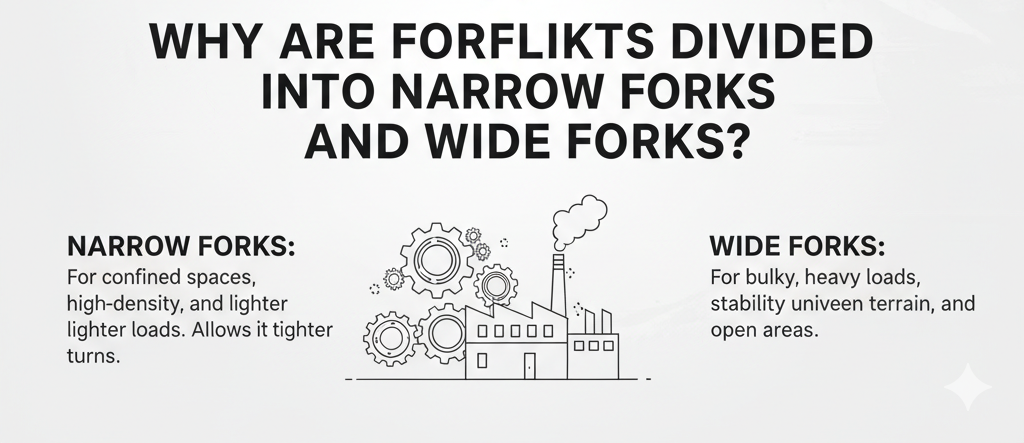
Narrow fork forklifts have a smaller fork width (usually around 550mm).
They are designed for small pallets and tight working spaces.
Wide fork forklifts have a larger fork width (usually 685mm or more).
They are suitable for large pallets, double-deck pallets, and heavy loads.
2. Why Are They Divided into Narrow and Wide Fork Types?
Fit Different Pallet Sizes
Not all pallets are the same size:
- Small pallets → narrow forks
- Large pallets → wide forks
Choosing the wrong type may result in inability to lift or unstable operation.
Ensure Safety During Operation
- Wide forks distribute weight better → safer for heavy loads
- Narrow forks lifting large pallets → risk of tilting or falling goods
Optimize Working Space
- Narrow aisles → narrow forks for better maneuverability
- Spacious warehouses → wide forks for faster and more stable operation
Improve Efficiency and Reduce Costs
Using the right forklift helps:
- Increase working speed
- Reduce pallet damage
- Improve productivity
Choosing the wrong one may lead to:
- Time loss
- Product damage
- Higher maintenance costs
3. Quick Comparison
| Criteria | Narrow Fork | Wide Fork |
|---|---|---|
| Fork Width | ~550mm | ~685mm |
| Pallet Type | Small, single-face | Large, double-face |
| Workspace | Narrow | Wide |
| Stability | Medium | High |
| Application | Small warehouses | Industrial warehouses |
4. How to Choose the Right Forklift?
Consider these 3 factors:
- Pallet size
- Warehouse space
- Load capacity
Quick suggestion:
- Small warehouse + small pallets → Narrow forks
- Large warehouse + heavy loads → Wide forks
5. Conclusion
Dividing forklifts into narrow and wide forks helps optimize:
- Work efficiency
- Safety
- Operating costs
👉 Choosing the right one from the beginning will save you time, money, and risks.