

How to Check If a Forklift Lead-Acid Battery Is Damaged
Th5
The lead-acid battery is one of the most important components of an electric forklift. When the battery becomes weak or damaged, the forklift may lose power quickly, operate inefficiently, and affect overall productivity.
So, how can you check whether a lead-acid battery is faulty? Below is a detailed guide to help you identify the condition of your forklift battery accurately.
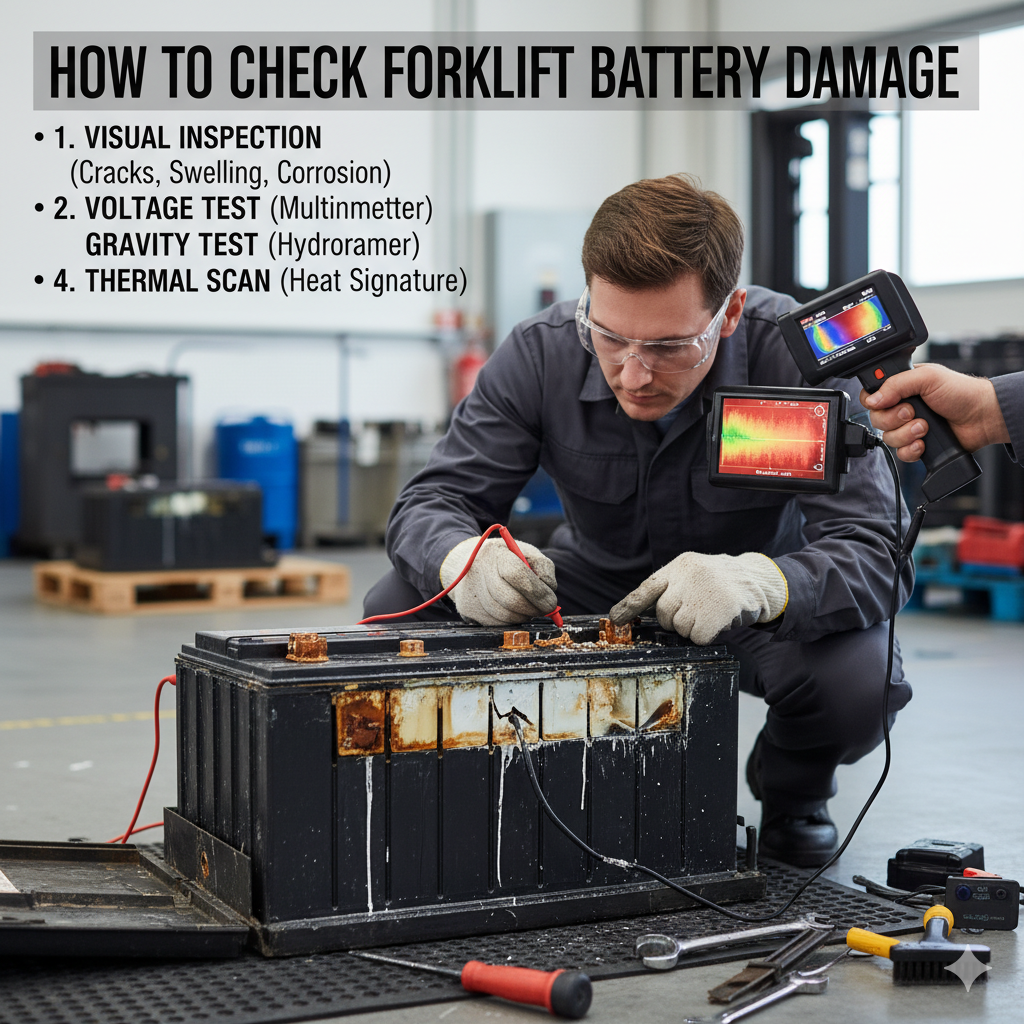
1. Inspect the Battery Exterior
Start by checking the outside condition of the battery.
Signs of a damaged battery include:
- Swollen or cracked battery case
- Acid leakage
- Corrosion around battery terminals
- Overheated cables or connectors
- Burnt smell or strong acid odor
If these symptoms appear, the battery may already be seriously deteriorated.
2. Measure the Voltage of Each Cell
A forklift lead-acid battery consists of multiple 2V cells connected together.
For example:
- 24V battery = 12 cells
- 48V battery = 24 cells
Use a multimeter to measure each cell:
- Healthy cell: around 2.1V after full charge
- Weak cell: below 1.9V
- Damaged cell: below 1.7V or 0V
Even one faulty cell can significantly reduce overall battery performance.
3. Check the Electrolyte Specific Gravity
Use a hydrometer to measure the acid specific gravity.
Standard reading after full charge:
- Around 1.26 – 1.28
Signs of battery failure:
- One cell has much lower specific gravity than the others
- Specific gravity does not increase even after long charging
This usually indicates sulfation or poor charge retention.
4. Check Battery Performance During Operation
If the forklift shows the following symptoms, the battery may be weak:
- Battery drains quickly
- Weak lifting power under load
- Charging takes too long
- Voltage drops sharply under heavy load
- Frequent battery error warnings
These are common signs of an aging or damaged battery.
5. Check Battery Temperature
After charging or operating:
- Slight warmth is normal
- One cell becoming much hotter than the others usually indicates internal damage
An overheated cell may be caused by internal short circuits or severe sulfation.
6. Test the Battery’s Charge Retention
After fully charging the battery, let it rest for several hours and measure the voltage again.
- Healthy battery: minimal voltage drop
- Faulty battery: voltage drops quickly even without use
This is an effective way to identify worn-out batteries.
Signs That a Forklift Battery Is Near the End of Its Lifespan
You should inspect or replace the battery if:
- Full charge lasts only 2–3 hours
- Battery frequently loses water
- Black sediment appears inside cells
- Battery boils excessively during charging
- Forklift feels weak even though the motor is still good
Typically, a lead-acid forklift battery lasts about 3–5 years depending on usage and maintenance.
Conclusion
Regular battery inspection helps detect problems early, reduces downtime, and saves repair costs.
If your battery shows signs such as:
- rapid voltage drop,
- incomplete charging,
- abnormal heat,
- or short operating time,
you should check it immediately to avoid more serious damage.
Proper maintenance such as:
- adding distilled water correctly,
- charging properly,
- and cleaning battery terminals regularly,
can greatly extend battery life.