

Why Does a Forklift Lose Power? Causes and Effective Troubleshooting
Th12
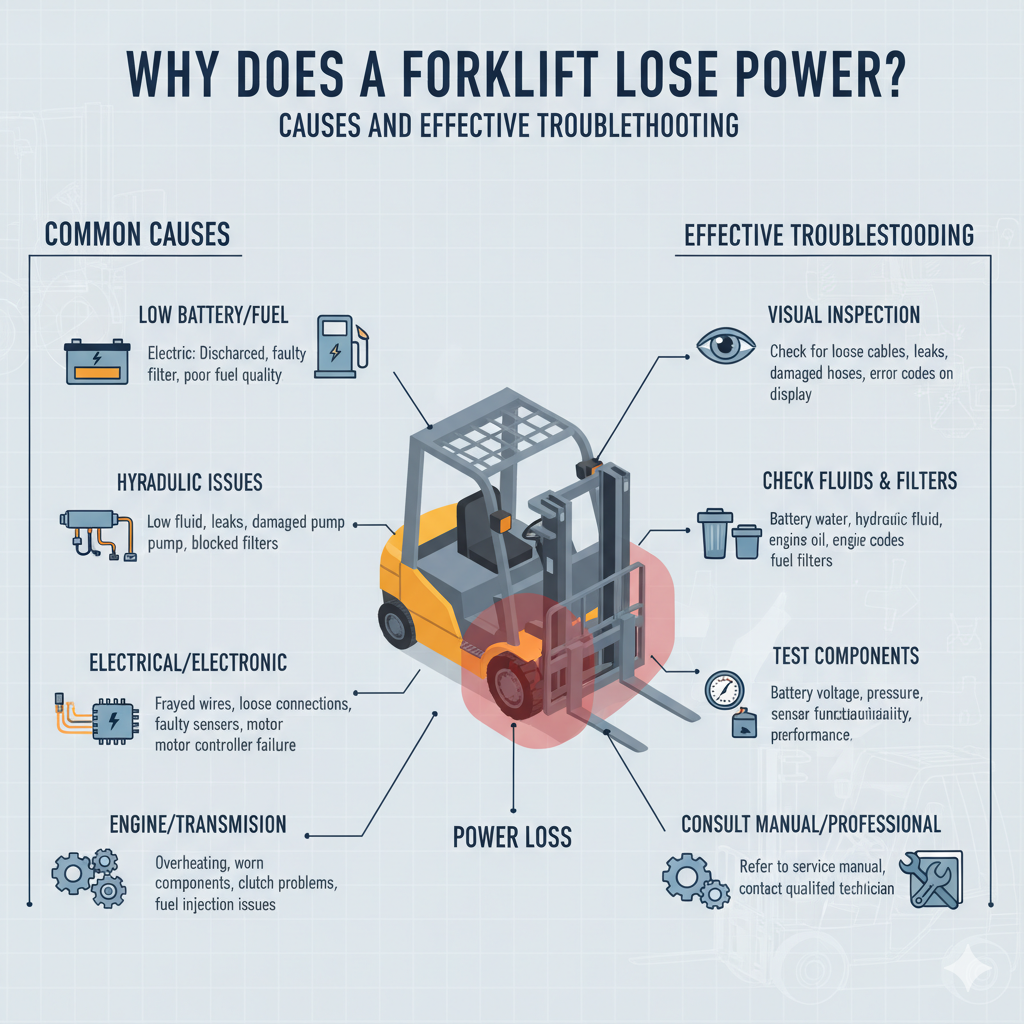
A forklift losing power is a common issue during operation, causing production downtime and additional repair costs. This problem can occur on both electric forklifts and diesel forklifts, ranging from simple causes like a weak battery to more serious issues related to the ECU or controller.
This article helps you understand the causes of forklift power loss, warning signs, and a professional troubleshooting process.
1. Battery – The Most Common Cause of Forklift Power Loss
🔹 Electric forklifts
-
Battery deeply discharged, voltage below safe level
-
Battery aging or damaged cells (especially lithium batteries)
-
Loose or corroded battery terminals
-
Damaged or broken battery cables
👉 Symptoms: No display, no response when turning the key
🔹 Diesel forklifts
-
Weak or dead starting battery
-
Corroded or loose terminals
-
Poor grounding (negative cable issues)
2. Fuse, Relay, and Power Switch Problems
-
Main fuse blown
-
Faulty power relay
-
Worn or damaged ignition switch
-
Emergency stop button engaged or stuck
👉 Many forklifts lose power simply because the emergency stop button is not released.
3. Safety Interlock System Prevents Power Supply
Modern forklifts are equipped with multiple safety switches. If any switch fails, the ECU will block power:
-
Seat switch not activated
-
Parking brake switch
-
Neutral gear switch
-
Door or hood safety switch
👉 The forklift has battery power, but the ECU prevents startup.
4. Wiring and Connector Issues
-
Loose or oxidized connectors
-
Broken or burnt wires
-
Water intrusion into the electrical box
👉 Common in outdoor or cold-storage forklifts.
5. ECU / Controller / Control Board Failure
-
ECU malfunction, no power output
-
Controller damaged by overload or water
-
Loss of 24V / 48V / 80V supply to ECU
👉 This type of failure usually involves higher repair costs.
6. Charger and BMS System (Electric Forklifts)
-
Faulty charger causing insufficient charging
-
Incorrect charging voltage triggering battery protection
-
Lithium battery BMS locking discharge
👉 Battery still has energy, but cannot supply power to the forklift.
7. Overlooked but Common Causes
-
Forklift unused for a long time causing deep discharge
-
Water entering electrical components after washing
-
Incorrect battery or charger installation
-
Error exists but display does not turn on
Standard Forklift Power Loss Troubleshooting Process
1️⃣ Measure battery voltage
2️⃣ Check battery terminals and ground cable
3️⃣ Check emergency stop button
4️⃣ Inspect main fuse
5️⃣ Inspect safety switches
6️⃣ Check ECU power connectors
7️⃣ Read error codes (if display is available)
📌 In practice: Over 70% of forklift power loss cases are caused by battery, terminals, or fuses—not ECU failure.
Frequently Asked Questions (FAQ)
Q1: Does a forklift with no display mean ECU failure?
👉 Not necessarily. Most cases are caused by weak batteries, blown fuses, or engaged emergency stop buttons.
Q2: Why does an electric forklift still have battery power but cannot move?
👉 The BMS may lock discharge, or a safety switch or controller may be blocking power.
Q3: A diesel forklift won’t start—does that mean power loss?
👉 Yes. Common causes include weak batteries, poor grounding, or faulty ignition switches.
Q4: Does leaving a forklift unused for a long time cause power loss?
👉 Yes. Batteries naturally self-discharge and may drop below safe voltage levels.
Q5: When should a professional technician be called?
👉 After checking the battery, fuses, and switches, or when ECU/controller failure is suspected.