

Why a 3-Phase Power System Needs Neutral and Ground Wires
Th11
Why a 3-Phase Power System Needs Neutral and Ground Wires
1. Overview of a 3-Phase Power System
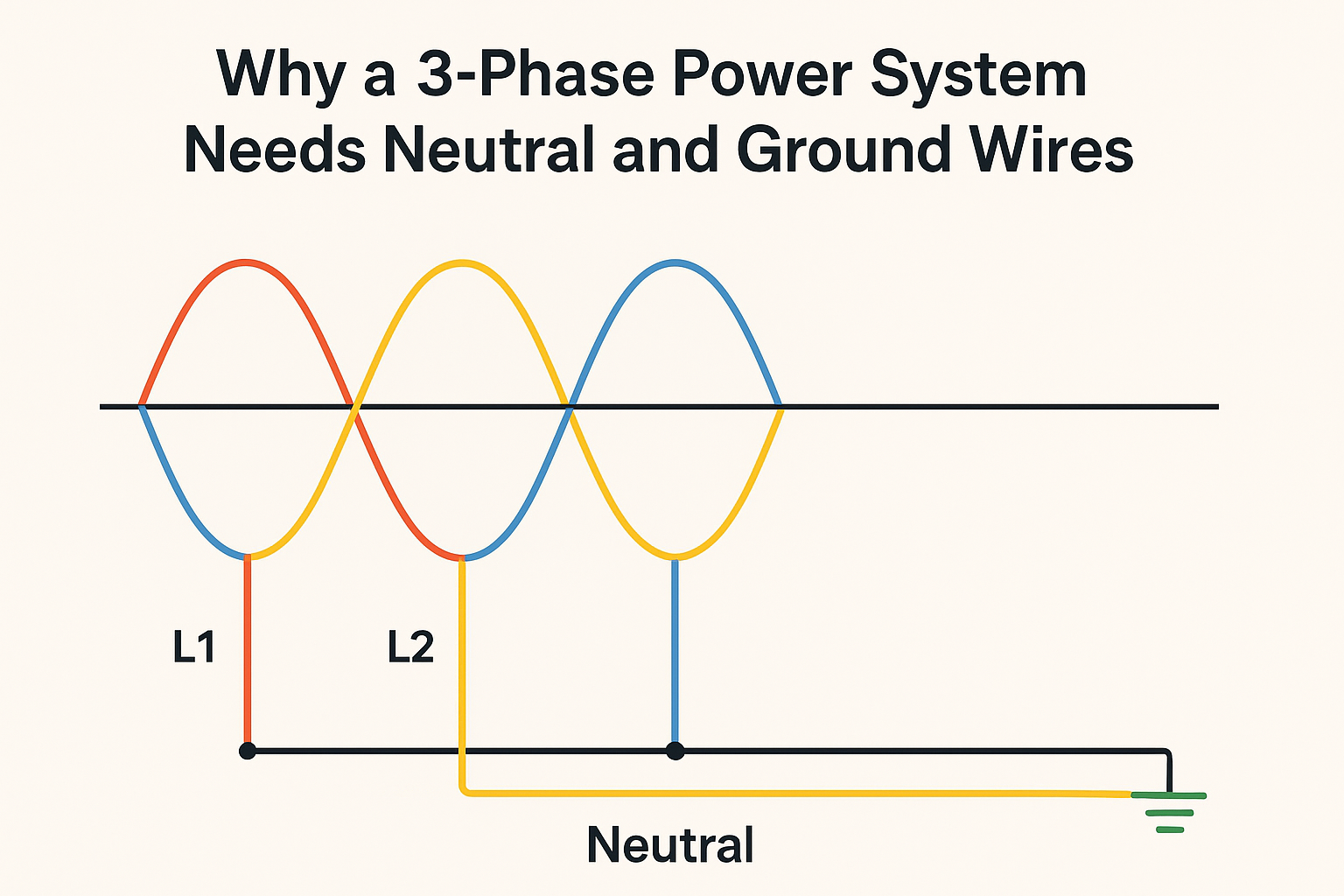
A 3-phase power system is widely used in industries, factories, and heavy-duty equipment. It consists of three live wires (R, S, T), each 120° out of phase, providing stable power transmission and higher efficiency for 3-phase motors.
Besides the three live wires, the system also requires a neutral wire (N) and a ground wire (PE) to ensure safety and stability.
2. The Role of the Neutral Wire
The neutral wire connects to the center point of the star (Y) connection in a generator or transformer.
Its main functions include:
-
Balancing voltage across phases: When the load is uneven, the neutral wire maintains voltage balance between phases.
-
Providing single-phase power: By combining one phase with the neutral wire, the system delivers 220V power for household equipment.
-
Stabilizing the system: It helps prevent voltage fluctuations and unbalanced phases.
3. The Role of the Ground Wire
The ground wire (also called protective earth wire, PE) connects the metal casing of electrical devices directly to the ground.
Its functions are:
-
Protecting human safety: In case of electric leakage, current flows safely into the ground instead of through the human body.
-
Protecting equipment: It prevents damage from overvoltage or lightning surges.
-
Stabilizing voltage: Reduces electrical noise and enhances system reliability.
4. How the System Works
With all three live wires, one neutral wire, and one ground wire, the 3-phase system delivers stable and safe electricity for both 3-phase and single-phase applications.
-
3 live wires: Main power transmission
-
Neutral wire: Voltage balancing and 1-phase supply
-
Ground wire: Safety protection and system stability
5. Conclusion
Using both the neutral wire and the ground wire in a 3-phase system is not optional—it’s essential for safety, stability, and proper performance. Always follow electrical standards during installation to prevent electric shock, fire, or system failures.
Q&A Section
❓1. Can we remove the neutral wire in a 3-phase system?
➡ No. The neutral wire balances voltage and enables single-phase power. Removing it may cause voltage imbalance and equipment failure.
❓2. Is the ground wire required in all electrical systems?
➡ Yes. Both single-phase and 3-phase systems require grounding for safety and protection from electrical leaks.
❓3. Can a 3-phase system be used in homes?
➡ Yes, but it’s only suitable for houses with large equipment such as air conditioners, pumps, or elevators. A qualified electrician should design the system for both 1-phase and 3-phase use.