

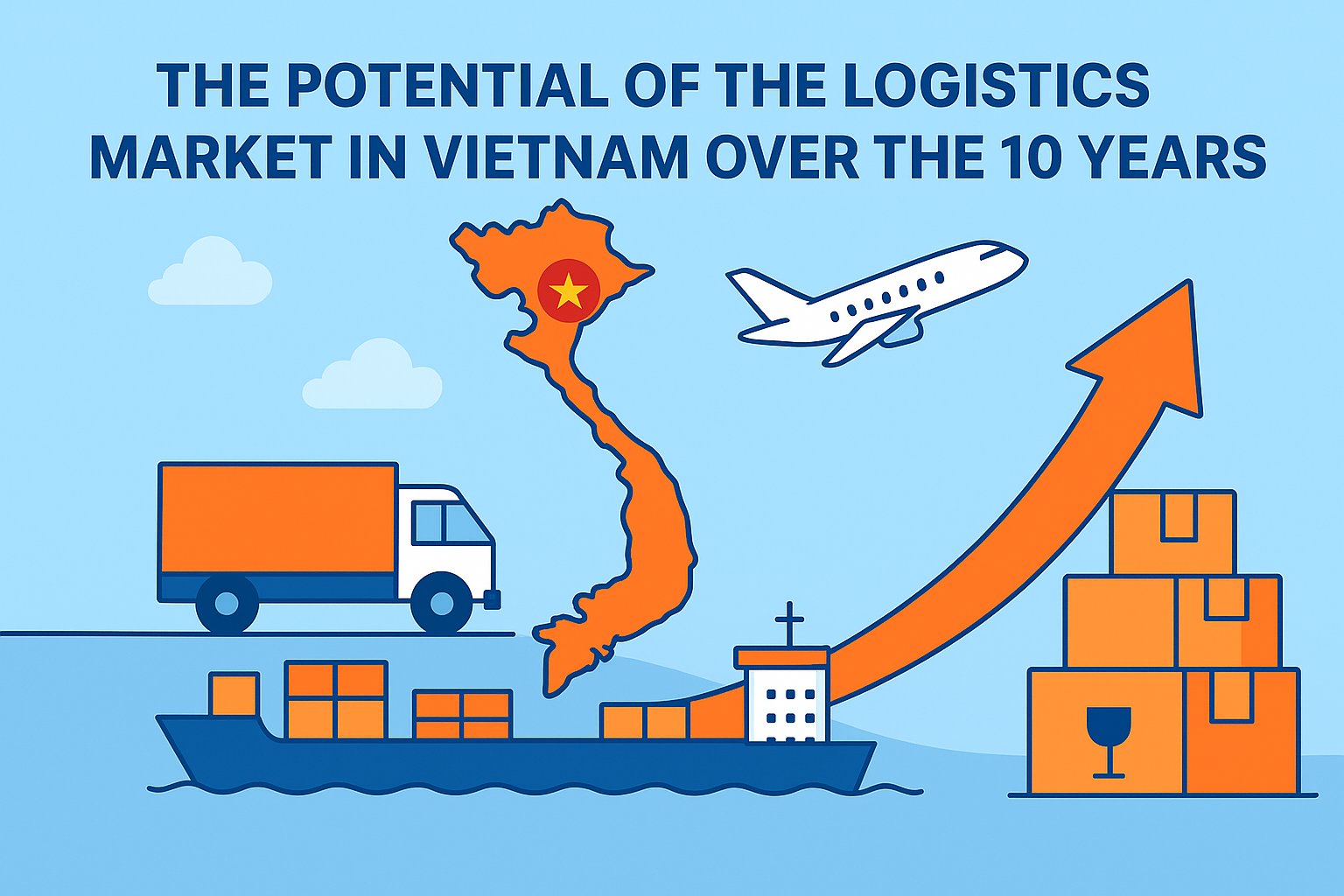
Potential of Vietnam’s Logistics Market in the Next 10 Years
Th8
Below is a comprehensive overview of the potential of Vietnam’s logistics market in the next 10 years (2025–2035), based on the latest strategies, opportunities, and challenges:
Strategic Goals and Expected Growth
According to the Logistics Development Strategy for 2025–2035, Vietnam sets the following goals:
-
Contribution to GDP: 5%–7%
-
Average annual growth rate: 12%–15%
-
Logistics outsourcing rate: 70%–80%
-
Reduce logistics costs to 12%–15% of GDP
-
Improve LPI (Logistics Performance Index) ranking to the global top 40 (from the current 43rd position)
(Hanoitimes, US-ASEAN Business Council)
Growth Opportunities
-
Expanding market demand: industry size reached USD 48–57 billion in 2024, projected to rise to USD 65–80 billion in the coming years
(US-ASEAN Business Council, sdlink.vn) -
Rising foreign investment: Vietnam becomes a top destination for production–logistics projects relocating from China under the “China + 1” strategy
(Financial Times) -
Government support: various incentives (tax, public investment), digitalization strategies, adoption of advanced technologies (AI, IoT, automation), and new FTAs (CPTPP, EVFTA, RCEP…) provide strong momentum
(reallogistics.vn, Vietnam Briefing, sdlink.vn) -
Rapid infrastructure improvement: construction of expressways (target 5,000 km by 2030), Long Thanh International Airport (phase 1 completed in 2026), and modern seaports (e.g., Hai Phong expansion)
(Wikipedia)
Key Challenges
-
High logistics costs, around 16.8%–18% of GDP, much higher than developed economies
(sdlink.vn, US-ASEAN Business Council) -
Shortage of skilled labor, especially in digital technology and smart supply chain management — estimated shortage of 2 million digital workers by 2030
(sdlink.vn, Vietnam Investment Review) -
Fragmented infrastructure across different transport modes (railways, ports, warehouses, roads) — requiring multimodal integration for optimization
(US-ASEAN Business Council, InCorp Vietnam)
Outlook 2025–2035
| Category | Target / Projection 2025–2035 |
|---|---|
| Logistics growth | 12%–15% annually |
| Market size | USD 65–80 billion (from USD 48–57 billion in 2024) |
| Logistics cost | Reduced to 12%–15% of GDP |
| Contribution to GDP | 5%–7% |
| Global LPI ranking | Top 40 (currently 43rd) |
| Technology & digitalization | 80% of enterprises adopt technology |
| Green energy adoption | 50% of logistics vehicles switch to green energy |
| Skilled workforce | 70% technically trained, 30% with university or higher degrees |
Conclusion
Between 2025 and 2035, Vietnam’s logistics market promises strong growth in both scale and quality, driven by an open economy, infrastructure investment, and digital transformation. However, to achieve these ambitious goals, challenges regarding costs, infrastructure, and workforce must be addressed.