

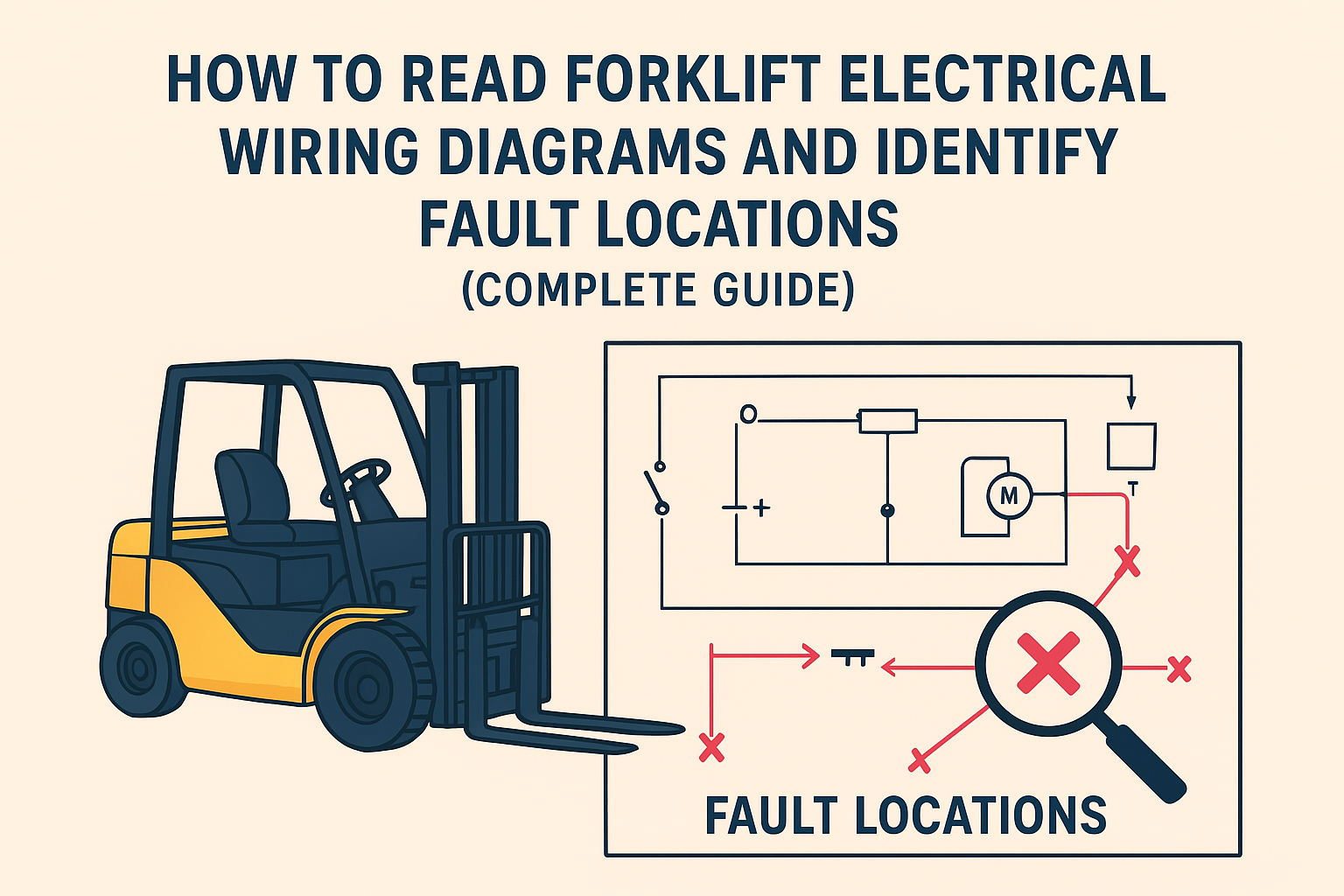
How to Read Forklift Electrical Wiring Diagrams and Identify Fault Locations (Complete Guide)
Th11
Introduction
Understanding how to read forklift electrical wiring diagrams is essential for technicians and operators. With the correct approach, you can quickly locate faults, fix issues, and keep the machine operating safely. This guide explains how forklift electrical diagrams work and how to diagnose errors step-by-step.
Table of Contents
-
Basic structure of a forklift wiring diagram
-
Common electrical symbols in forklift diagrams
-
Four-step method to read forklift diagrams
-
How to locate faults based on symptoms
-
Signs of electrical failures
-
SEO keyword list
-
FAQ
1. Basic Structure of a Forklift Electrical Wiring Diagram
Forklift diagrams usually contain four main sections:
1.1 Power Source (Battery Section)
-
Symbols: B+, B-, 24V/48V/72V
-
Includes: Battery or lithium pack → Fuse → Main switch
This is the first area to check when the forklift loses power.
1.2 Control Circuit
Includes:
-
Joystick switches
-
Limit switches
-
Safety sensors
-
Control PCB
-
Small control contactors
This circuit uses low-voltage signals and has the highest failure rate.
1.3 Power Circuit
Handles high current loads:
-
Lift motor
-
Drive motor
-
Steering motor
-
Power contactors (K1, K2, K3)
1.4 Safety & Sensor Circuit
Examples:
-
Seat switch
-
Brake switch
-
Lift limit switch
-
Inching sensor
Any sensor failure → the truck disables related functions.
2. Common Symbols in Forklift Electrical Diagrams
| Symbol | Meaning |
|---|---|
| K1, K2, K3 | Power contactors |
| M1, M2 | Motors |
| S1, S2 | Switches |
| F1, F2 | Fuses |
| LS | Limit Switch |
| ECU/Controller | Central control unit |
| CAN BUS | Communication line |
3. Four-Step Method to Read Forklift Electrical Diagrams
3.1 Step 1: Identify the power path
Trace from B+ → Fuse → Main Switch → Controller.
3.2 Step 2: Follow the circuit related to the faulty function
Example: forklift cannot lift
B+ → Fuse → Lift switch → Lift contactor → Lift motor.
3.3 Step 3: Diagnose from easiest to hardest
-
Broken wire
-
Burned fuse
-
Faulty switch
-
Limit switch not activated
-
Contactor coil not energized
-
Controller output error
-
Motor failure
3.4 Step 4: Test with a multimeter
-
Check input/output voltage
-
Check continuity
-
Check grounding
-
Check contactor coil voltage
Where voltage disappears → that is the fault location.
4. How to Locate Faults by Symptom
4.1 Forklift has no power
-
Main fuse blown
-
Bad main switch
-
Loose ground wire
-
Lithium BMS cutoff
4.2 Forklift cannot lift
-
Lift switch S1
-
Limit switch LS
-
Contactor K1
-
Lift motor M1
4.3 Forklift cannot drive
-
Brake switch
-
Seat switch
-
F/R switch
-
Drive contactors
-
Drive controller
4.4 Controller error codes
-
Hall sensor errors
-
CAN BUS errors
-
Overcurrent
-
Motor stall
5. Signs of Electrical Failures
-
Open circuits in the diagram → broken wire
-
Limit switch not closing → lifting disabled
-
Contactor not energizing → coil voltage missing
-
No B+ at controller → fuse or wiring fault
-
No output to motor → controller or contactor failure
6. FAQ
1. Where can I find the wiring diagram?
Usually inside the service manual or near the controller compartment.
2. Can I diagnose a forklift without a wiring diagram?
Not recommended; wrong measurement may damage the controller.
3. Why does the contactor not engage?
Possible reasons: low coil voltage, broken wire, or safety switch not activated.
4. What multimeter should I use?
A True-RMS digital multimeter for accurate readings.