

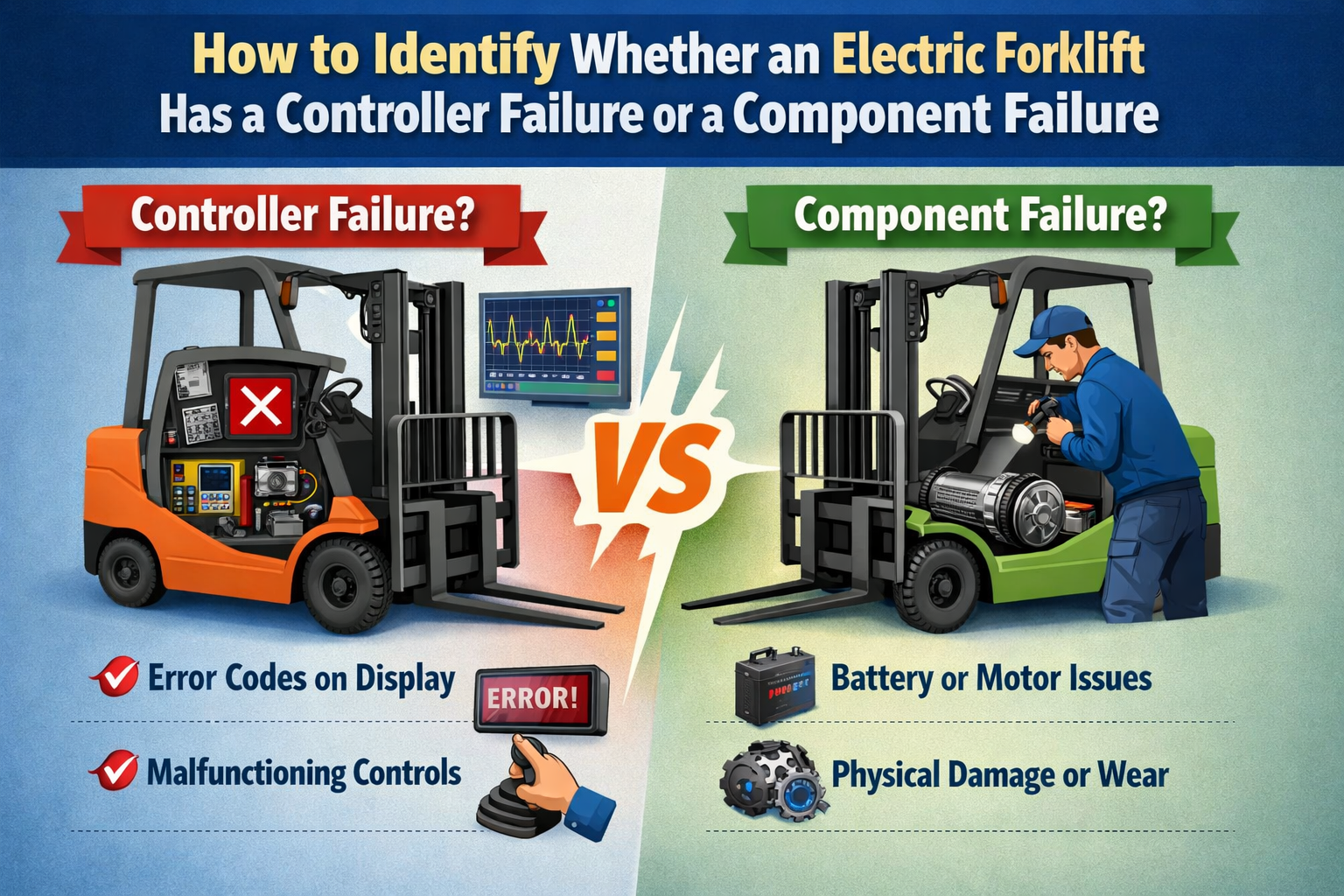
How to Identify Whether an Electric Forklift Has a Controller Failure or a Component Failure
Th12
Introduction
Electric forklifts are widely used in warehouses and factories thanks to their efficiency and environmental friendliness. However, when an electric forklift stops working, cannot lift, or loses power, many people mistakenly assume the controller (control board) is faulty, leading to unnecessary and costly replacements.
This article will help you accurately distinguish between a controller failure and a component failure using standard technical inspection methods.
1. What Is an Electric Forklift Controller?
The controller (PCB) is the central control unit of an electric forklift. It is responsible for:
-
Driving and speed control
-
Lifting and lowering operations
-
Receiving signals from sensors and safety switches
-
Protecting motors and batteries
👉 When the controller fails, the forklift often becomes unstable or completely inoperable.
2. Signs of a Faulty Controller
You should suspect a controller failure if the forklift shows the following symptoms:
-
Complete power loss while the battery still has voltage
-
Error codes that cannot be cleared
-
Intermittent operation, jerking or unstable movement
-
Controller overheating or burning smell
-
Input voltage present but no output to motor or hydraulic pump
📌 Two or more of these symptoms strongly indicate controller failure.
3. Signs of a Component Failure
In many cases, the controller is still working properly, and the issue is caused by external components:
-
Display is on, but the forklift does not move or lift
-
Only one function fails (driving works but lifting does not, or vice versa)
-
Forklift works again after replacing relays, fuses, or switches
-
Failure occurs after battery or charger replacement
Common faulty components include:
-
Fuses
-
Relays
-
Safety switches
-
Sensors
-
Wiring and connectors
4. Standard Inspection Procedure
Step 1: Check the Battery and Power Supply
-
Measure battery voltage (24V / 48V / 80V)
-
Inspect battery connectors, main circuit breaker, and main fuse
📌 Low battery voltage can cause the controller to shut down, leading to misdiagnosis.
Step 2: Check Fuses and Relays
-
Blown fuses can cause total power loss
-
Damaged relays can prevent driving or lifting
Step 3: Check Safety Switches and Sensors
-
Seat switch, key switch, steering switch
-
Brake sensor, accelerator sensor
📌 A single faulty safety switch can disable the entire system.
Step 4: Read Error Codes
-
Use the display or manufacturer software (Curtis, ZAPI, EP)
-
Compare error codes with official fault charts
👉 Sensor-related errors usually do not require controller replacement.
Step 5: Inspect the Controller
-
Check for burned components or swollen capacitors
-
Look for corrosion or water damage
-
Measure input and output voltage
📌 Input voltage present but no output means the controller is faulty.
5. When Should the Controller Be Replaced?
-
Severe controller damage or burnt circuits
-
Water immersion causing corrosion
-
Incorrect battery voltage connection
-
All other components have been ruled out
👉 Controller replacement should only be done after thorough inspection.
Q&A
Q: The electric forklift does not move. Is the controller damaged?
A: Not necessarily. This is often caused by faulty safety switches, relays, or sensors.
Q: What causes complete power loss in an electric forklift?
A: Possible causes include blown fuses, weak batteries, circuit breakers, or a faulty controller.
Q: The forklift drives but does not lift. What is the issue?
A: Common causes include solenoid valves, lift relays, pump motors, or lift controller circuits.
Q: Is controller replacement expensive?
A: Yes. Therefore, a full inspection should be performed before replacing the controller.
Q: Can electric forklift controllers be repaired?
A: Minor damage may be repairable, but severe damage usually requires replacement.