

How the ZAPI Controller Works on Electric Forklifts
Th10
How the ZAPI Controller Works on Electric Forklifts
1. Introduction to the ZAPI Controller
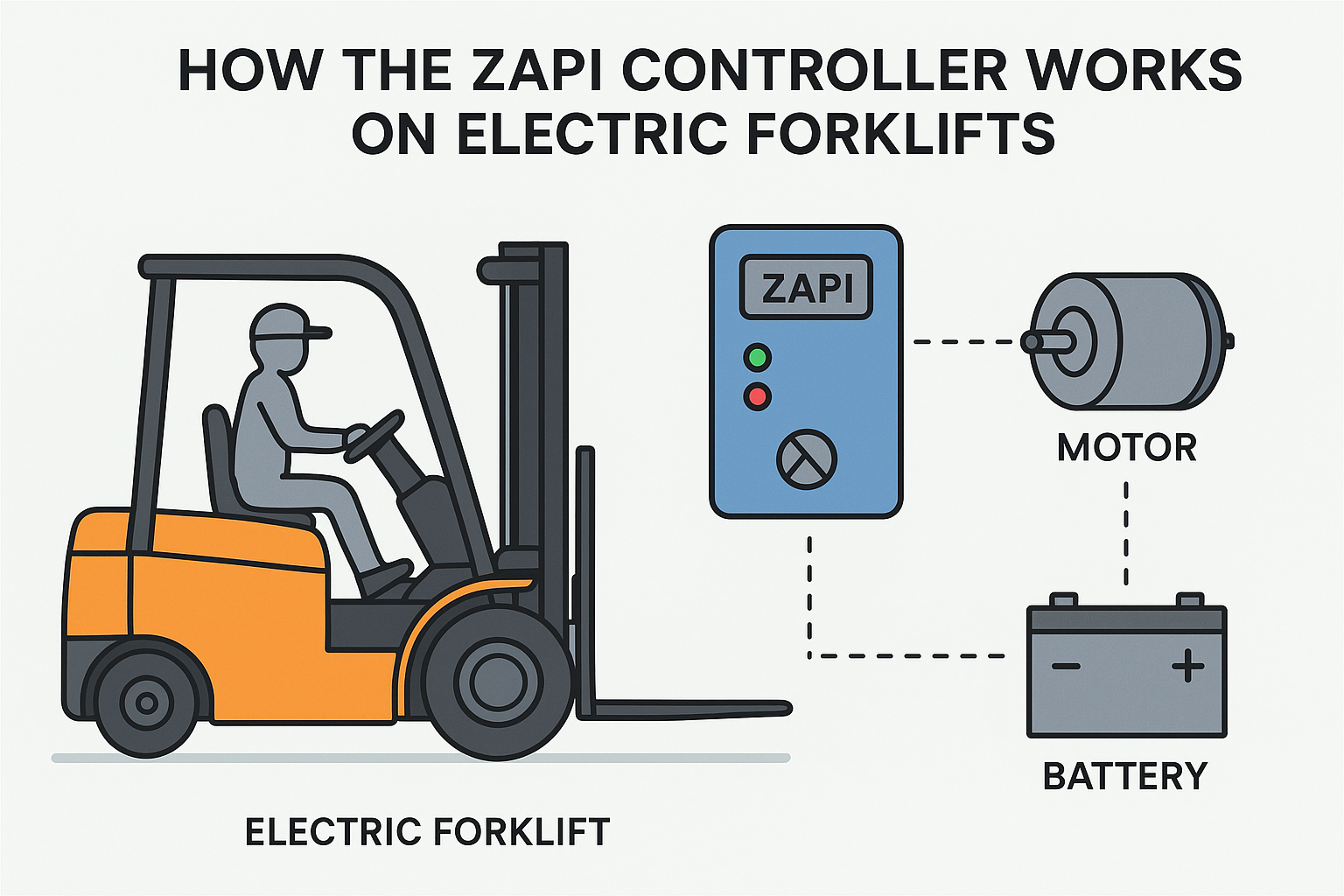
The ZAPI Controller is the central control unit developed by ZAPI – Italy, widely used in high-end electric forklifts such as EP, Heli, Linde, Yale, and Still.
Its main function is to control the motor’s speed, direction, and torque based on signals from the accelerator, sensors, and safety switches.
2. Basic Structure of the ZAPI Controller
A ZAPI controller typically consists of four main parts:
-
Power Section:
-
Receives power from the battery (24V, 48V, 80V, etc.).
-
Uses IGBT or MOSFET transistors to regulate motor current.
-
-
Logic Control Section:
-
The microprocessor (CPU) processes signals from the accelerator, brake, forward/reverse switch, and position sensors.
-
It generates control pulses (PWM) for the power section.
-
-
Feedback Section:
-
Receives feedback from the encoder, current sensor, and speed sensor to adjust torque output.
-
Ensures smooth operation and protects the motor.
-
-
Protection & Diagnostics:
-
Monitors temperature, voltage, and short-circuit conditions.
-
Displays error codes when a fault occurs for easy troubleshooting.
-
3. Working Principle
🔹 Step 1: Receiving Control Signals
When the operator presses the accelerator pedal or selects forward/reverse, a voltage signal (0–5V) is sent to the controller.
ZAPI interprets this signal as the requested speed and direction.
🔹 Step 2: Logic Processing
The microprocessor checks all safety conditions (brake, seat switch, speed limits, etc.).
If valid, it generates PWM signals to control motor power.
🔹 Step 3: Motor Power Control
The IGBT module rapidly switches current on and off to the motor in PWM form.
→ The pulse width determines motor speed and torque.
→ More throttle = wider pulses = higher motor current = faster speed.
🔹 Step 4: Feedback & Auto Adjustment
ZAPI receives continuous feedback from:
-
Encoder: detects motor speed and position.
-
Current & temperature sensors: limit output to protect components.
This forms a closed-loop control system, keeping the forklift stable and energy-efficient.
🔹 Step 5: Regenerative Braking
When decelerating or braking, the ZAPI controller reverses current flow, turning the motor into a generator.
The recovered energy is fed back to the battery, extending its lifespan and saving power.
4. Advantages of the ZAPI Controller
-
⚙️ High control precision and fast response.
-
🔒 Excellent reliability and safety.
-
💡 Self-diagnostic with error codes.
-
🔋 Regenerative braking for energy recovery.
-
🌍 Widely used in European electric forklifts.
5. Conclusion
The ZAPI Controller acts as the “brain” of an electric forklift, managing all key operations — from acceleration and braking to energy regeneration.
Understanding its working principle helps technicians diagnose faults accurately and operators use forklifts more efficiently.