

How an Electric Forklift Operates from Key Switch to Driving (A–Z Guide)
Th12
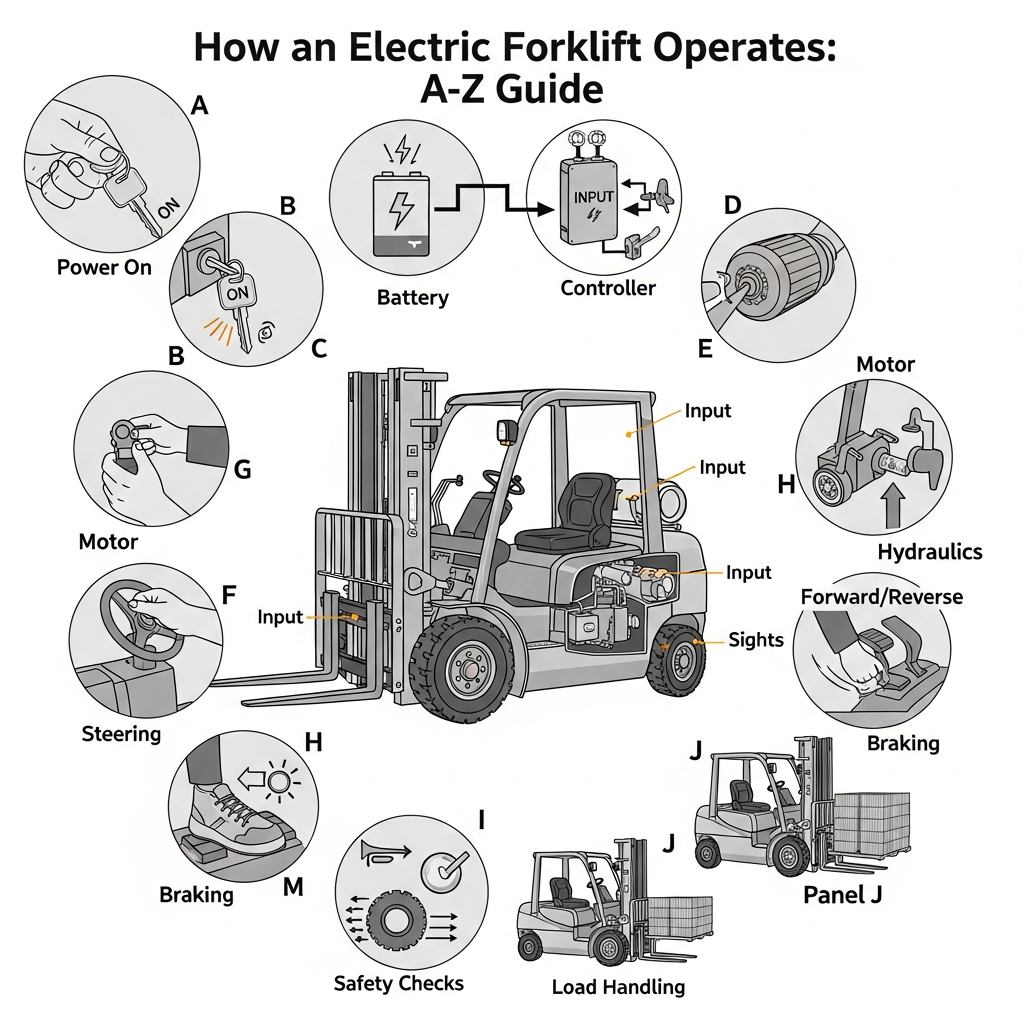
Electric forklifts are widely used in warehouses and factories thanks to their smooth operation, low operating cost, and environmental friendliness. However, many users still do not clearly understand how an electric forklift actually works internally, from turning the key to when the forklift starts moving.
This article explains the complete operating process of an electric forklift step by step, suitable for operators, technicians, and forklift dealers.
1. Turning the Key – Activating the Main Electrical System
When the ignition key is turned to the ON position:
-
DC power is supplied from the battery (lead-acid or lithium)
-
Power flows through:
-
Main fuse
-
Emergency stop switch
-
Key switch
-
-
The main controller (ECU) is powered on
At this stage:
-
The display turns on
-
Battery level and system indicators appear
-
The forklift is ready, but not moving yet
2. Safety System Check Before Driving
Before allowing movement, the controller checks multiple safety conditions:
-
Seat switch detects an operator
-
Parking brake is released
-
Direction lever is in Neutral
-
No critical faults from:
-
Motor
-
Controller
-
Accelerator or brake sensors
-
❗ If any condition is not met:
-
The forklift will not move
-
A fault code may appear
-
You may hear a relay click but the motor will not rotate
3. Brake Release – Electromagnetic Brake Operation
Most electric forklifts use an electromagnetic brake.
When stopped:
-
The brake is engaged
-
The motor shaft is locked
-
The forklift remains stationary, even on slopes
When the operator:
-
Releases the brake
-
Presses the accelerator
👉 The controller energizes the brake coil:
-
The brake releases
-
The motor shaft is unlocked
✔️ This design ensures safety:
Power loss = brake automatically engages
4. Pressing the Accelerator – Sending Control Signals
The accelerator pedal does not directly power the motor.
Instead:
-
A sensor (potentiometer or Hall sensor) sends a voltage signal
-
Example range: 0.8V – 4.2V
-
The signal represents desired speed
The controller calculates:
-
Current
-
Voltage
-
Motor speed
-
Travel direction (forward / reverse)
5. Controller Powers the Drive Motor
Once all conditions are met:
-
The controller uses IGBTs or MOSFETs
-
Converts DC power using PWM signals
-
Supplies controlled power to the traction motor
The motor:
-
Rotates
-
Transfers torque through the gearbox
-
Drives the wheels
🚜 The forklift starts moving smoothly without jerking.
6. Speed and Direction Control During Operation
While driving, the controller continuously monitors:
-
Motor current
-
Motor temperature
-
Battery voltage
-
Load conditions
When changing direction:
-
Speed is reduced first
-
The motor stops
-
Direction is safely reversed
-
Acceleration resumes
This protects:
-
The motor
-
Gearbox
-
Battery system
7. Releasing Accelerator or Braking – Stopping the Forklift
Releasing the accelerator:
-
Controller reduces PWM output
-
Motor slows down
-
Regenerative braking may occur
Pressing the brake:
-
Mechanical brake + electromagnetic brake engage
-
Motor power is cut
-
The forklift stops and is held securely
8. Turning the Key OFF – System Shutdown
When the key is turned OFF:
-
Controller loses power
-
Motor power is cut
-
Electromagnetic brake engages
-
The forklift enters a fully safe state
Electric Forklift Operating Process Summary
-
Turn key ON → system powered
-
Safety checks completed
-
Brake released
-
Accelerator signal sent
-
Controller powers motor
-
Forklift moves
-
Brake or release accelerator → stop
-
Key OFF → system shutdown
Frequently Asked Questions (Q&A)
Q: Why does the forklift power on but not move?
A: Possible causes include engaged brake, seat switch not activated, low battery, or controller fault.
Q: Does an electric forklift have a clutch like a diesel forklift?
A: No. Electric forklifts are fully electronically controlled.
Q: Will the forklift roll if power is lost?
A: No. The electromagnetic brake automatically engages.
Q: Why does an electric forklift feel weak?
A: Usually due to weak battery, overheating motor, or controller current limiting.
Q: Does an electric forklift need warm-up time?
A: No. It can operate immediately once powered on.