

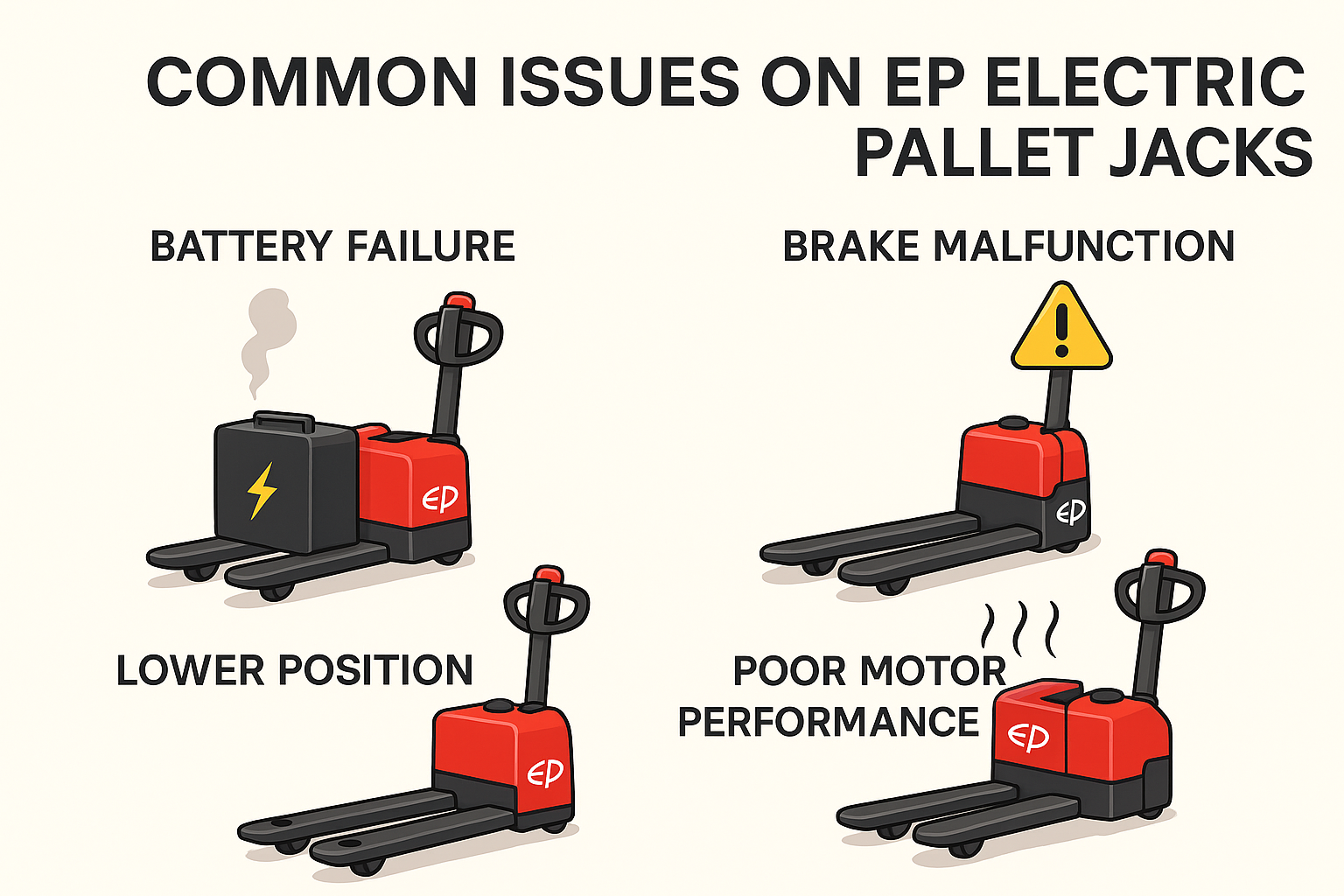
Common Errors on EP Electric Pallet Trucks
Th9
Below are some common issues with electric pallet trucks (such as electric pallet trucks and stackers) – applicable in general, including EP models – along with possible causes and troubleshooting suggestions. If you specify the exact type (EP pallet truck, EP stacker, EP reach, capacity, production year, error code displayed), I can provide more detailed information.
Common errors, causes & solutions
| Error | Symptoms | Possible causes | Troubleshooting & Solutions |
|---|---|---|---|
| No power / cannot start | Truck does not operate when the switch is turned on, no signal | Battery discharged, main fuse blown, loose contact, key switch faulty, broken or loose wiring | Check battery voltage; inspect fuses; check contacts and wiring; check safety interlock |
| Sudden power loss during operation | Truck stops suddenly, loses lifting or driving power | Loose battery connection, broken wire, poor contact, controller fault | Inspect battery connectors, check wiring, review error codes on controller |
| Reduced speed / slow driving | Truck runs slower than usual, weak pulling force | Low voltage, poor electrical connections, high friction on wheels, lack of lubrication in gearbox | Check battery and voltage; clean and tighten connections; lubricate gearbox and bearings; check wheels |
| Cannot lift / weak lifting | Forks cannot lift or lift very slowly | Low hydraulic oil, oil leakage, damaged cylinder seals, faulty solenoid valve, pump motor failure | Check hydraulic oil level; inspect cylinder, seals, hoses; check solenoid valve; check pump motor |
| Cannot lower forks | Forks cannot lower or lower very slowly | Blocked return oil hole, faulty lowering valve, clogged pipeline | Clean oil return hole; check lowering valve; inspect hoses |
| Brake not working / weak brake | Truck cannot stop when switch is released, brake cannot hold | Brake coil broken or shorted, damaged wire, excessive brake gap, brake controller fault | Inspect brake coil; check wiring; adjust brake gap; check brake controller |
| Noise or vibration during operation/lifting | Unusual noise or vibration when running or lifting | Worn bearings, deformed or dirty wheels, misaligned gearbox, high friction | Replace bearings/wheels; clean wheels; lubricate axle; adjust gearbox |
| Hydraulic oil leakage | Oil leakage at cylinder, seals, hoses | Worn seals, cracked hoses, poor assembly | Replace seals; check hoses; tighten fittings |
| Sensor/controller error (error code on display) | Error code shown, limited function | Faulty shaft sensor, current sensor, CAN connection, software/hardware failure in controller | Read error codes; check signal wiring; inspect sensors; replace controller if needed |
| Battery/accumulator failure | Low capacity, voltage drop under load, swollen or leaking battery | Aged battery, sulfation, loose cells, electrolyte problem, loose terminals | Replace if necessary; clean terminals; check acid batteries’ electrolyte level; maintain lithium battery connectors and tray (EP connectors may be damaged if hit during installation) |
Some typical EP error codes & explanation
| Error Code | Message | Explanation |
|---|---|---|
| F1.1 | Motor Temp Hot | Motor overheating – possibly overloaded or operating in hot environment |
| F1.2 | Throttle Fault | Throttle error – open/short circuit in signal wire, faulty throttle sensor |
| F1.3 | Undervoltage Cutback | Battery voltage too low or poor battery connection |
| F1.4 / F1.5 | Overvoltage / Severe Overvoltage | Battery voltage too high, unstable circuit |
| F2.1 | SRO Fault | Interlock / safety switch fault, broken signal wire |
| F2.3 | Main Driver Fault | Main relay/contact fault, open circuit or damaged |
| F3.2 | Brake On Fault | Brake coil or brake circuit fault |
| F5.1 | Low BDI | Battery discharge indicator low |
| F5.2 / F5.3 | Controller Overtemp / Severe Overtemp | Controller overheating |
Notes & Tips to Reduce Errors
-
Perform regular maintenance: check electrical connections, clean and tighten contacts.
-
Inspect and clean battery trays and connectors (EP trays/connectors are prone to damage if hit when installing battery).
-
Avoid overloading and continuous work in high-temperature environments.
-
Use the correct type of battery and charging method – for lead-acid, check electrolyte and add distilled water if needed.
-
When encountering error codes, record the error code, condition, and time of occurrence for accurate diagnosis.
-
Keep circuit diagrams / EP technical manuals to look up error codes, sensors, and control circuits.