

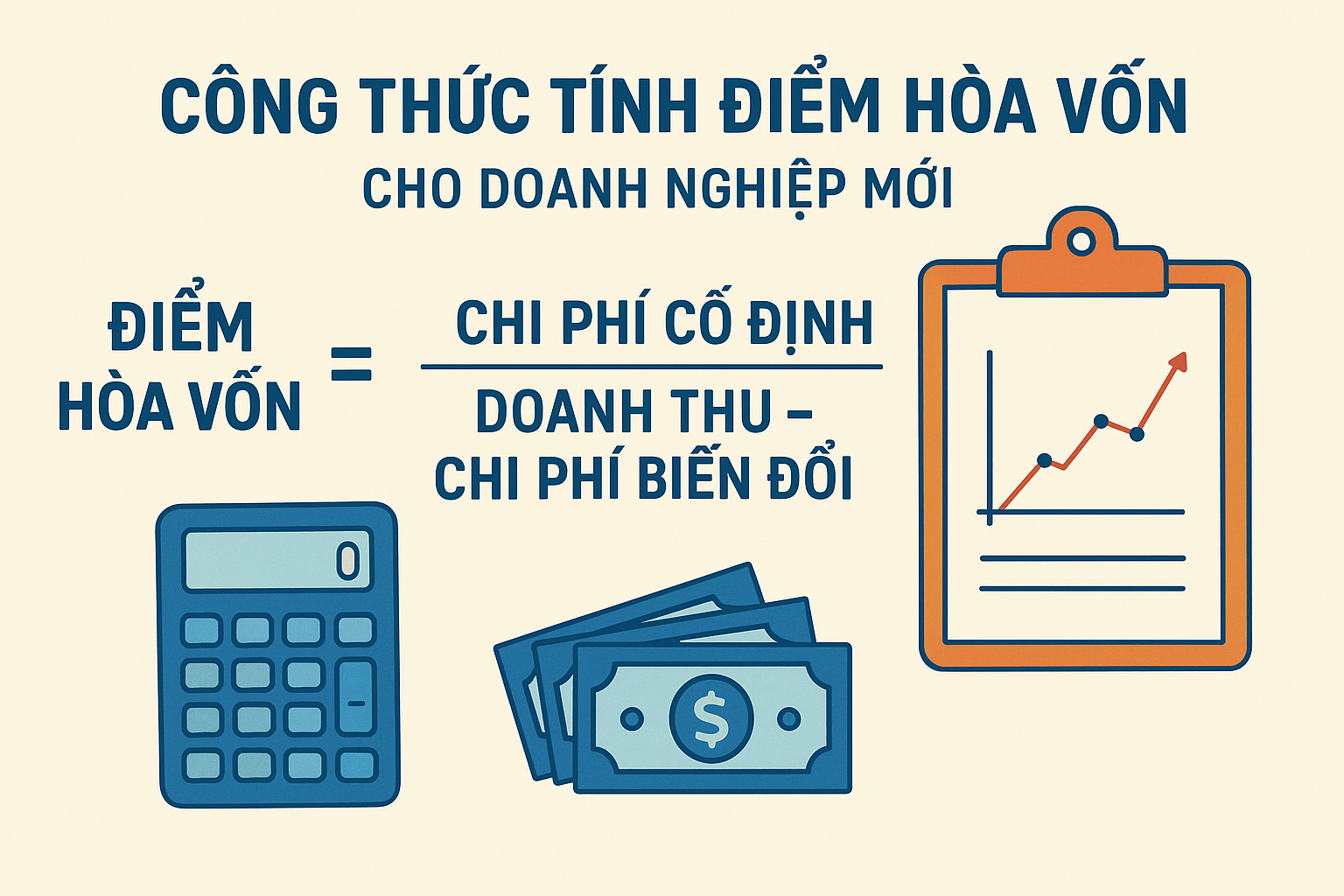
Break-even Point Formula for New Businesses
Th9
What is the break-even point?
The break-even point is the level of revenue or output at which a business neither makes a profit nor incurs a loss – in other words, total revenue = total costs.
Determining the break-even point helps new businesses understand the minimum sales required, thereby allowing them to plan operations and finances more effectively. This is an important tool for startups and small businesses when entering the market.
Break-even point formulas
1. Break-even point by quantity (Q)
QBE = FC / (P – VC)
Where:
-
QBE: break-even quantity (the number of units that must be sold to break even).
-
FC: fixed costs (e.g., rent, management salaries, depreciation, administrative expenses).
-
P: selling price per unit.
-
VC: variable cost per unit (e.g., raw materials, direct labor, production electricity).
-
(P – VC): contribution margin per unit.
2. Break-even point by revenue (R)
RBE = FC / (1 – VC / P)
Where:
-
RBE: break-even revenue.
-
Other notations are the same as above.
Example: Calculating the break-even point
Assume a new business has:
-
Fixed costs (FC) = 100,000,000 VND/month
-
Selling price (P) = 500,000 VND/unit
-
Variable cost (VC) = 300,000 VND/unit
👉 Break-even quantity:
QBE = 100,000,000 / (500,000 – 300,000) = 500 units
👉 Break-even revenue:
RBE = 500 × 500,000 = 250,000,000 VND
Benefits of determining the break-even point
-
Helps new businesses identify the minimum output and revenue required to avoid losses.
-
Serves as a basis for setting pricing strategies and controlling costs.
-
Supports business decision-making: expand, downsize, or maintain the current scale.
Conclusion
The break-even point formula is a vital financial tool for new businesses. By mastering this calculation, you can better plan, analyze costs, and develop effective business strategies.