

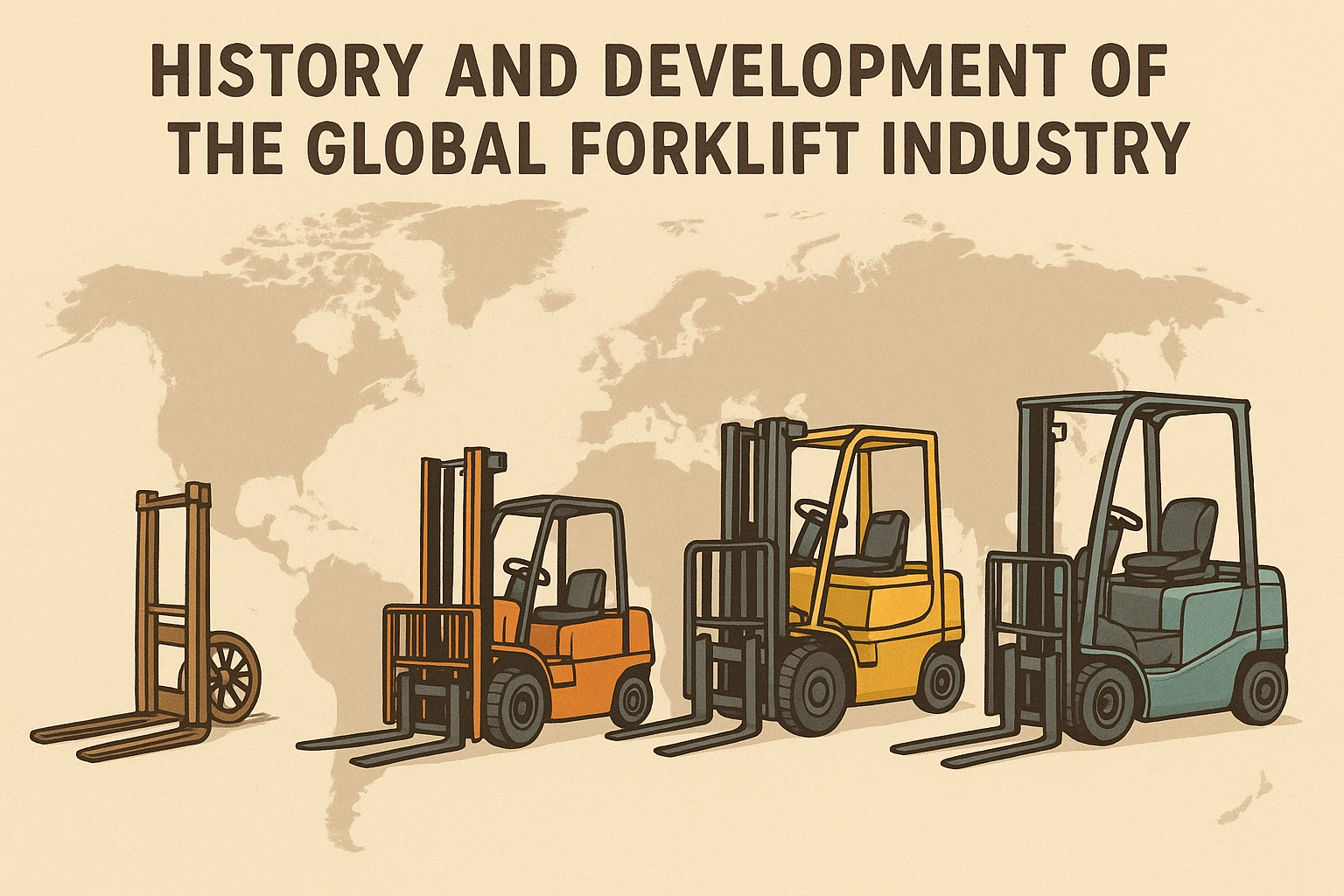
History and Development of the Global Forklift Industry
Th11
The forklift industry was born from the need to move and handle goods more efficiently in factories and warehouses. Over more than 100 years, forklifts have evolved into an essential tool in logistics, manufacturing, and global commerce.
1. Early Stage (Before 1917)
Before modern forklifts existed, loading and lifting work relied mainly on human labor or mechanical carts. Some simple lifting devices were invented but lacked standardized technology.
2. Birth of the Modern Forklift (1917–1920)
-
During World War I, the demand for transporting military supplies increased rapidly.
-
In 1917, Clark (USA) created the first forklift, named Tructractor, which is considered the “father” of modern forklifts.
-
Between 1918–1920, Yale & Towne introduced the first electric forklifts using electric motors for lifting.
3. Technological Expansion (1930–1950)
-
The introduction of standardized pallets made forklifts more efficient and widely used.
-
Forklifts were upgraded with hydraulic lifting systems, allowing higher and safer lifting.
-
World War II significantly pushed demand as logistics operations expanded rapidly.
4. Modernization Era (1950–1980)
-
Major brands such as Toyota, Hyster, Caterpillar, Mitsubishi, Komatsu entered the market.
-
Internal combustion forklifts (gasoline, diesel, LPG) became popular for warehouses and ports.
-
Safety technologies improved: stronger masts, better brakes, and OSHA-standard designs.
5. The Electric Forklift Era (1980–2010)
-
Environmental concerns drove the rise of electric forklifts.
-
Lead-acid batteries were widely used due to their low cost.
-
Asian brands became more dominant globally, especially those from Japan and later China.
6. Lithium Battery Revolution & Automation (2010–Present)
Lithium-Ion Technology
-
Faster charging
-
Longer operating hours
-
Maintenance-free
-
3–4 times longer lifespan vs lead-acid batteries
Leading brands: BYD, EP Equipment, Linde, Toyota.
Autonomous Forklifts – AGV/AMR
-
Equipped with sensors, cameras, radar, and AI
-
Capable of operating without a driver
-
Widely used in smart factories and automated warehouses
IoT Integration
-
Real-time monitoring of battery, load, and working hours
-
Predictive maintenance and error alerts
-
Data-based optimization
7. Future Trends
-
100% electrification in warehouses
-
Intelligent automation and unmanned forklifts
-
AI-powered logistics optimization
-
Advanced 360° safety systems