

What Are IC and Transistor? Easy Explanation and Applications in Electric Forklifts
Th11
What Are IC and Transistor? Easy Explanation and Applications in Electric Forklifts
1. General Introduction
When studying electronic circuits, you often hear about two familiar components: IC and Transistor.
They are essential parts that help control, amplify, and process signals in almost every electronic device — especially in electric forklifts, control boards, and sensor systems.
This article explains in simple terms what IC and Transistor are, along with their structure, functions, and real-world applications.
2. What Is a Transistor?
🔹 Definition:
A Transistor (also called a semiconductor device) is an electronic component that can amplify or switch electrical current.
It acts like an intelligent electronic switch, allowing a large current to flow when a small control signal is applied.
🔹 Structure and Working Principle:
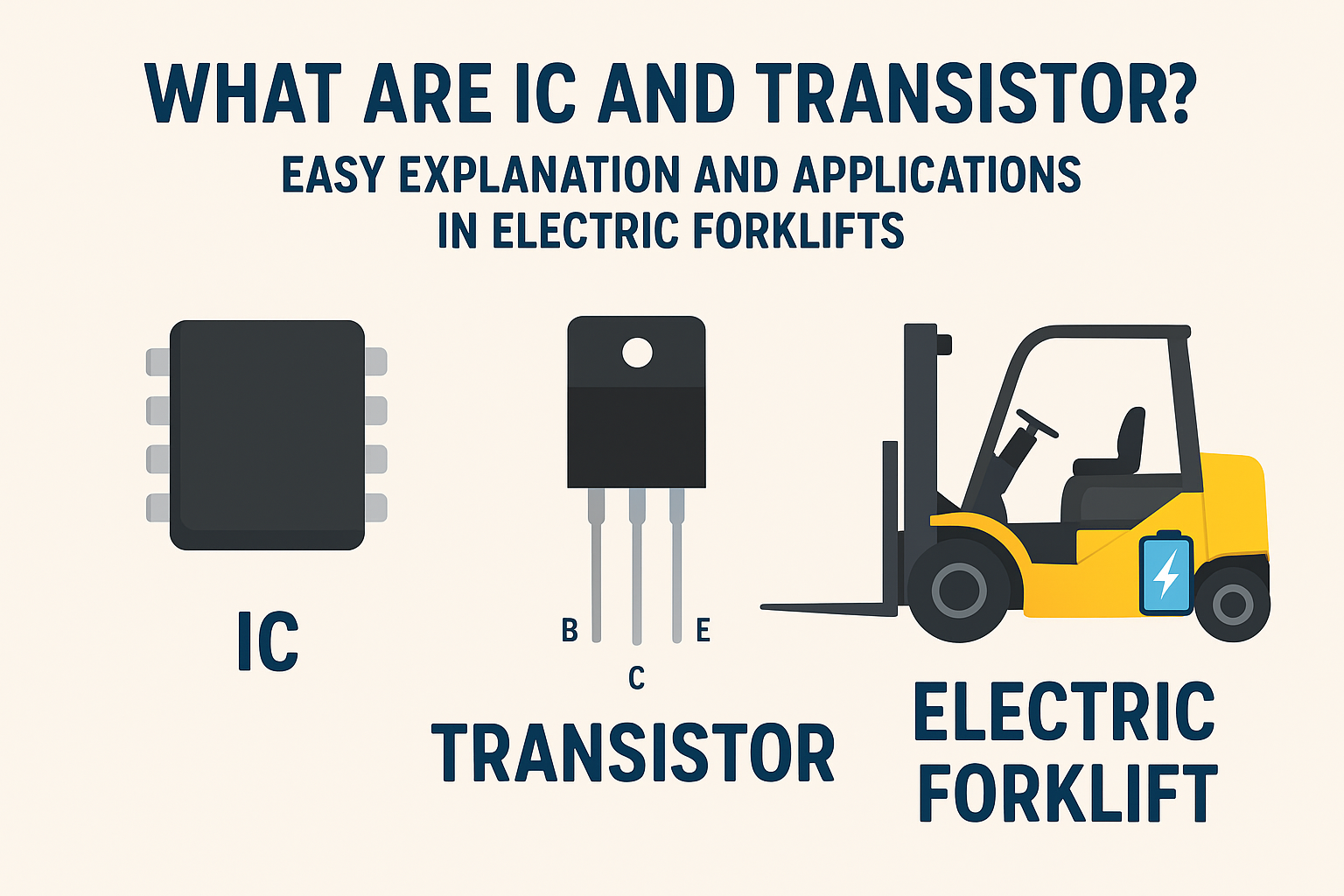
A transistor typically has three terminals:
-
B (Base) – control terminal
-
C (Collector) – current input
-
E (Emitter) – current output
When a small voltage is applied to the Base, the transistor allows a larger current to flow from Collector to Emitter — controlling motors, relays, or lights.
🔹 Applications in Electric Forklifts:
-
Controls lifting motors or steering motors.
-
Switches power to the hydraulic pump.
-
Protects the circuit from overcurrent conditions.
👉 In short, the transistor acts as the “gatekeeper” controlling electrical current in forklift control boards.
3. What Is an IC?
🔹 Definition:
An IC (Integrated Circuit) is a tiny chip that contains many transistors and other electronic components integrated inside.
It serves as the brain of the circuit.
🔹 Common Types of ICs:
-
Amplifier ICs (Op-amps) – used for audio or signal amplification.
-
Logic ICs – process binary (0/1) signals.
-
Microcontroller ICs – used in forklifts to process and control the entire system.
🔹 IC Applications in Forklifts:
-
Receives signals from throttle, lifting sensors, and safety switches.
-
Processes data and sends commands to power transistors.
-
Ensures the forklift operates smoothly, safely, and efficiently.
4. Comparison Between IC and Transistor
| Feature | Transistor | IC (Integrated Circuit) |
|---|---|---|
| Function | Amplify or switch current | Process, compute, and control |
| Structure | 3 pins (B, C, E) | Contains hundreds or millions of transistors |
| Complexity | Simple | Very complex |
| Use in Forklifts | Controls motors and pumps | Processes signals and system control |
5. Importance of IC and Transistor in Electric Forklifts
In modern electric forklifts, ICs and transistors are core components of the control system.
-
The IC works as the brain — processing data from sensors.
-
The Transistor acts as the muscle — executing commands to drive motors or relays.
If either fails, the forklift may show problems such as:
-
Unable to lift or lower,
-
Motors not running,
-
Error lights appearing on the display panel.
6. Conclusion
Both IC and Transistor are essential components that ensure an electric forklift operates smoothly, safely, and efficiently.
Understanding their functions and working principles helps in troubleshooting, repairing, or replacing parts when needed.