

Advantages and Disadvantages of Investing in Forklifts in Production
Th8
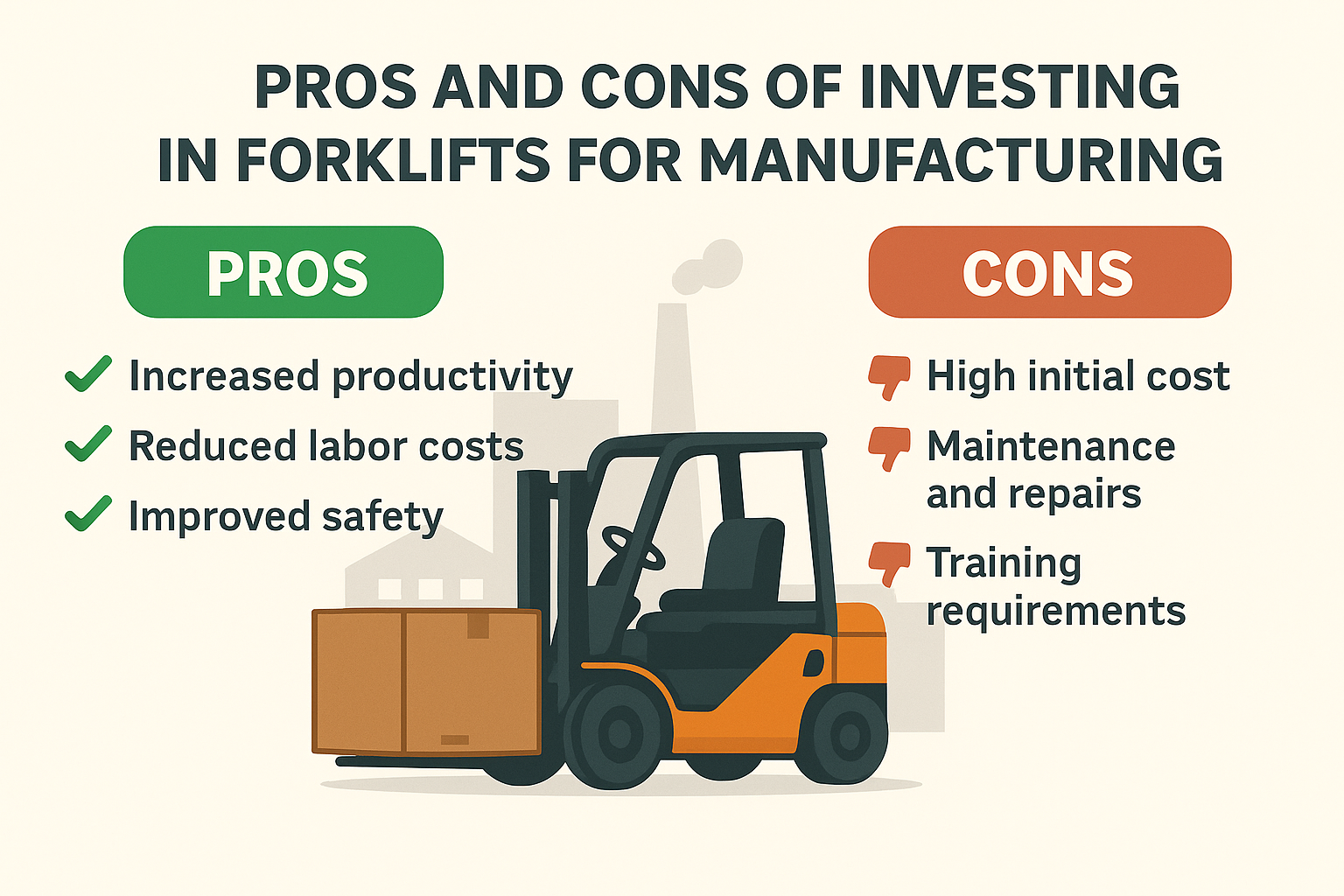
When a business invests in forklifts for production, there are many advantages, but also some disadvantages to consider. Here’s a detailed summary:
✅ Advantages of Investing in Forklifts
-
Increased productivity: Speeds up the movement and lifting of goods compared to manual labor.
-
Labor savings: Reduces the number of workers needed, requiring only a few trained operators.
-
Improved safety: Standardized forklifts help minimize workplace accidents, especially with heavy and bulky goods.
-
Optimized warehouse space: Enables stacking at higher racks, maximizing vertical warehouse capacity.
-
Versatility: Various forklift types (manual, electric, diesel, semi-electric, reach trucks…) fit different industries.
-
Operational stability: Ensures production and logistics processes run smoothly without labor shortages.
-
Long-term value: Forklifts are depreciable assets that add value to the business.
❌ Disadvantages of Investing in Forklifts
-
High initial cost: Purchasing new forklifts, especially lithium battery models, requires significant investment.
-
Maintenance and operating costs: Forklifts need regular servicing (battery, oil, spare parts…).
-
Operator requirements: Drivers must be trained and certified to ensure safety.
-
Asset depreciation: Forklifts lose value over time and will eventually need replacement.
-
Storage space needs: Requires parking areas, charging stations (for electric forklifts), or fuel storage (for diesel/gas).
-
Dependence on technical condition: If a forklift breaks down, production and logistics may be delayed.
-
Difficulty in choosing the right model: Selecting the wrong type (overcapacity, mismatched with warehouse layout) may cause inefficiency and waste.
👉 Conclusion: Forklifts are a valuable investment that boosts productivity, safety, and efficiency, but businesses should carefully weigh costs, actual needs, and maintenance planning to maximize long-term benefits.